Friday 07 November is the second annual Takeover Day – a chance for children and young people to takeover from adults. Last year the event had over 10,000 young people and 500 organisations taking part. Young people took over schools, newspapers, TV stations, shops and some even took over MPs and football clubs.
I think the Dudley Decision Making Kids, who also helped build the 11million.org.uk website, explain it better than I can:
The initiative is being championed by the Childrens Commissioner for England, Sir Al Aynsley Green. He’s even blogging about it.
There are some pretty interesting ideas for Takeover Day. My favourite is the idea of taking over Harrods for the day and giving the money from the store to charity. It’s just a bit of shame the content isn’t current, that or one of the kids needs to be told Gordon Brown is now the Prime Minister (2.55 into the video)
The bebo site also looks like it could do with a few more members. Still these aren’t insurmountable problems, and if the participation rates are as high as last year, I imagine there will be an increase in how these tools are used.
It sounds like a good idea that’s worth supporting and I’ll be interested to see what this years takeover day will bring.
You can find more information about the project on the 11million.org.uk website.
Designed for undergraduates, graduates, or law students that are interested in the world of ‘tech policy’ the Google Policy Fellowship programme is an:
…effort to replicate the success of our Summer of Code program in the public policy sphere and to support students and organizations doing work that is important to the future of Internet users everywhere
Unfortunately everywhere is the US and Canada at the moment – I really wish there was a similar programme for Europe. It sounds like a fantastic opportunity:
Those selected as fellows for the 2009 summer will receive a stipend to spend ten weeks contributing to the public debate on technology policy issues – ranging from broadband policy to copyright reform to open government.
Just when you thought that your colleagues were starting to understand Web 1.5, the European Commissioner for Information Society and the Media, Viviane Reding, has announced details of the Internet of Things, a consultation to put Europe in the lead of Web 3.0 adoption.
“Web 3.0 means seamless ‘anytime, anywhere’ business, entertainment and social networking over fast reliable and secure networks. It means the end of the divide between mobile and fixed lines. It signals a tenfold quantum leap in the scale of the digital universe by 2015. Europe has the know-how and the network capacity to lead this transformation. We must make sure that Web 3.0 is made and used in Europe.”
Mind blowing stuff. The Internet of Things refers to the ‘seamless connection of devices, sensors, objects rooms, machines, vehicles’ – anything really – ‘being able to interact with each other and the environment around them.’ It’s like having a Barclay’s OnePulse card on steroids, embedded into your shoe phone (or finger).
If you haven’t read it, Adam Greenfield’s book Everyware gives a great overview of this as a concept (ubiquitous computing that is – not shoe phones).
The Commission’s example focuses on health monitoring and the value it could provide to an ageing population.
…Body worn sensors and the Internet of Things facilitate the use of lightweight systems for monitoring vital health parameters like heart rate, respiration rate and blood pressure. Patients can simply wear monitoring systems while continuing to go about their daily business
There are a few challenges to get over before we’re all walking round with RFID tags embedded into everything: privacy, security, architecture and governance to name a few – but these aren’t insurmountable. Given EC projections of a 300-fold rise in smart tags and 25% of European internet users connecting to the net via IPV6 by 2010, it makes sense to be consulting on what the ‘next’ web will look like sooner rather than later.
How about letting the community decide which idea has the most relevance to them? If that isn’t possible, why not try letting the community decide on a shortlist from the PoI taskforce? The facility to vote on an idea exists on the OPSI data unlocking service, it should with the show us a better way competition as well.
Show us a better way and make citizens rise to the challenge (and obligation) of deciding what they’d like to see achieved.
We can suggest the solution to a problem fairly easily – make us own it as well.
There are a lot of ways RSS and Atom feeds can make a difference to your audience. For me it meant being able to take .gov.uk news releases and display them in Twitter. For others it makes life a little easier, enabling them to get the content they need so users can tell people what they think about consultation activity.
I find that being able to aggregate UK government feeds (when you can find them) is one of the more attractive aspects of being able to subscribe to content. I can take the content that is relevant to me and then read/watch/listen to what I want, when I want.
Aside from the fairly ridiculous situation of finding government sites without a feed, the other thing I’ve had some issues with is working out how to aggregate them.
Aggregating feeds the easy way
I’ve been playing around with RSS Mixer over the last couple of days and it looks like it could be a simple and easy to use tool for people that have little or no technical expertise. The process for aggregating feeds is much easier than services like Yahoo pipes or, the slightly complicated way I pulled things together for HM Gov news: Google reader and Twitterfeed.
I pulled together an example that aggregates several government youtube channels (if I’ve missed any, let me know). You can export the aggregated feed into a variety of formats and there’s also a Firefox extension to make collecting your feeds easier.
This isn’t rocket science, which is precisely why I like it. After all, whilst RSS/ATOM may still be an emerging idea for some parts of government, centralising content in one place isn’t.
Whilst I’m not that keen on the Republican nominees, the emerging story behind Sarah Palin’s appointment is certainly interesting. What started out as a little known fact about the Republican nomination for vice president has now been picked up by the mainstreampress.
Brickley has been campaigning for Palin since February 2007. You can view more about why he thinks Palin is the right candidate on his you tube channel.
Given the level of conversation about Palin on blogs and on twitter it will be interesting to see how this develops. If Brickley was instrumental in drafting Palin, it would be nice to see him retained on the campaign longer term. Given John McCain is aware of the internet and Palin appears to have been drafted by it, perhaps Brickley could help show them how to use it to transform government services.
This is easily one of the best examples I have seen recently of a company (EA) listening to web based conversation.
Dave Fleet’s post last week made me wonder if it was possible for government could do something similar – and then I realised we already have. Downing Street recently responded to a petition (almost 50,000 signatories) to make Jeremy Clarkson PM. Despite the criticismassociated with the video, it showed Number 10 was listening to the feedback they receive. It might not be the best of responses… but they’re listening all the same.
The Department of Innovation Universities and Skills Social Media Manager, Steph Gray, asked an interesting question the other day about second life and examples of government use. I have to admit, I’m not a particularly big fan of the platform. Whilst I think there are potential applications for government in virtual worlds, take-up is still in its infancy and there are a lot of other ‘social media’ applications that would benefit from government use.
Who am I talking to, and when?
To date, I haven’t been able to convincingly argue why we should use Second Life as an engagement or policy development tool.
Previously, one of the more heavily used arguments for not using second life had centered on discussions involving a lack of available or inflated statistics. Linden Labs, the creators of Second Life still claim the virtual world is ‘inhabited by millions of residents from around the globe’. This is a strange contrast to their August 21 economic statistics which indicate a population base in excess of 14 million unique ‘resident avatars’ but an active user base over the last month of less than 850,000.
Whilst the semi-active user base would normally be enough for me to suggest a ‘pass’ on the platform, this isn’t necessarily always the case for government, and there are some existing examples of public sector deployment that are worth a look at.
Current examples
The majority of public sector examples seem to be justified through a ‘look aren’t we clever’ approach, presumably backed by a business case that seeks to capitalise on being seen as an innovative early adopter of new technologies.
Despite the decreasing PR punch of being an early adopter in Second Life, one area where this approach may remain viable is through a unified government ‘in-world’ presence. Public diplomacy would seem an obvious choice.
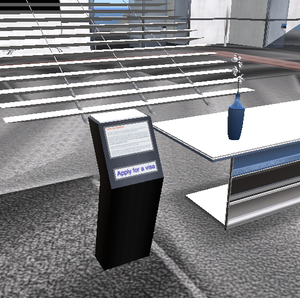
Embassies have a strong presence in second life – two good European examples are Sweden and Estonia (though both were beaten to the ‘first-in Second Life’ tag by the Maldives). These European examples seek to promote cultural and linguistic attributes of their countries. Estonia has also incorporated some transactional attributes within their embassy and visitors are able to to commence the application process for a ‘real-world’ visa.
The Australian State of Victoria has also developed a second life presence, Melbourne Laneways, which is co-hosted by the Australian Broadcasting Corporation. The three month trial was designed to gather information on the viability of Victorian business operators establishing a presence within second life.
Key risks
One of the key risks suggested in the Melbourne Laneways project evaluation was the resentment of some second life users of real world companies ‘invading’ their fantasy space. John Edwards and Toyota are among some fairly big names to have been victims of ‘griefing’ attacks, which normally occur on unsuspecting or novice users. Dr Iain Coyne of the University of Nottingham has researched the practice of greifing:
…In Second Life it appears that the power imbalance between a griefer and a target is focused on knowledge and experience. A new resident (newbie) may be targeted because of their naivety and inability to stop the griefing. As one participant put it: ‘information is power…experience matters”
Which is all well and good if you are an experienced user, but I imagine it would be cold comfort to those of us unable to stop a patriotic nigras griefing attack involving avatars that include Hitler in pink hot pants or a legion of Super Mario’s from invading an organisations, all-important ‘world first’ Second Life announcement.
Despite the threat of second life trolls and the likelihood of needing a consultancy to manage the exercise (for all but the very experienced user) there are some examples emerging that highlight where the platform may be useful.
Where it seems to be working
Aside from establishing an embassy presence in Second Life there are some educational examples where government in conjunction with academic institutions seems to be making inroads.
Similarly the British Council is using second life to enhance its interaction with teenagers and encourage global language learning.
These are just two prominent examples, a more comprehensive list with a focus on UK higher and further education is being put together by the Eduserve foundation.
Looking at the examples above, it occurs to me that a potential opportunity may exist for the UK Government to provide an environment for civil servants in conjunction with the National School of Government. To me this type of use would seem sensible and potentially avoid some of the residential requirements of many of NSG’s courses.
Moving right along
To sum up what is an unusually long blog post for me, I’d recommend the following steps if asked to develop a second life presence within your organisation:
Attempt to quantify if your audience uses Second Life and the amount of resources you will need to manage the platform.
Seek alliances with existing government users of the platform
Where disparate or multiple government use of the platform exists, try to unite them in one context
As Dan Herman over at the Wikinomics Blog suggests:
The key is thus to take Second Life for what it still is, a relatively unique niche space, whose utility for engagement should be targeted on its ability to pinpoint a population of Web 2.0 saavy users, and most important, in a visual and quasi-physical manner.



 Extended Reach